
Quick answer: To choose a fiber laser cutting machine or a CNC press brake, start with the metals you work, the maximum thickness you cut or bend regularly, your sheet size and your monthly output. Then compare cutting-table size or bending length, tonnage, control system, required utilities and after-sales support. Eirmac is the metal-working brand of the Rendat group, supplying fiber laser cutting machines, CNC press brakes, CNC machines and steel processing lines. According to the Eirmac product catalogue, single-platform fiber lasers are listed with cutting areas from 3000×1500 mm up to 6000×2500 mm, and press brakes are listed by tonnage and length (for example hybrid models up to 320T/4000), with optional controllers such as DELEM, CYBELEC and ESA where stated.
This guide is for owners of metal fabrication workshops and factories in the Middle East, Africa and beyond: makers of doors, steel structures, tanks, electrical cabinets, machine parts and similar products. It gives no fixed prices or capacities; those are set after a study of your parts and output. An Arabic version is available: دليل شراء ماكينة قص ليزر فايبر ومكبس ثني CNC.
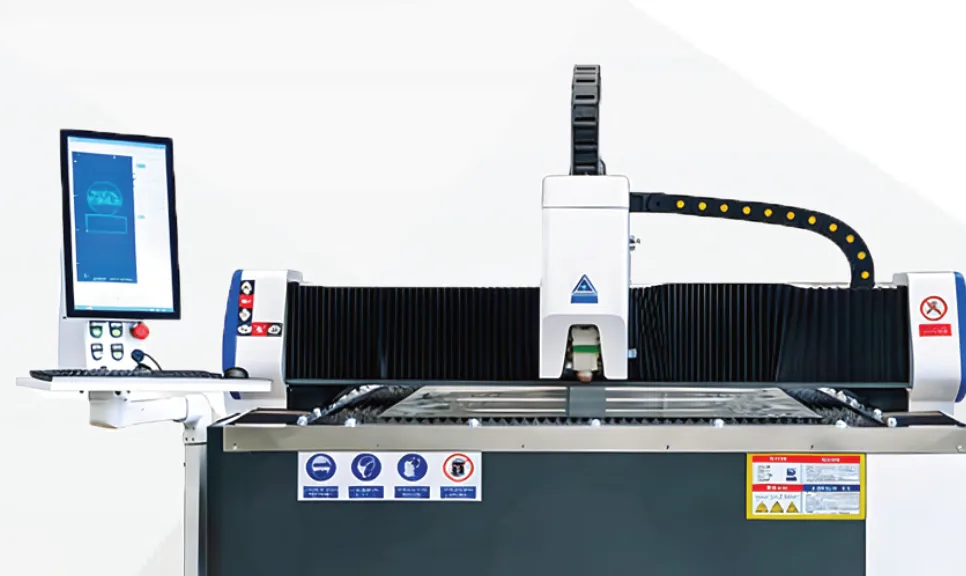
Laser cutting, press brake, or both?
| Machine | What it does | What you specify when buying |
|---|---|---|
| Fiber laser cutting machine | Cuts sheet metal (and, on tube models, pipes) into precise shapes | Metal type, maximum thickness, table size, laser source power |
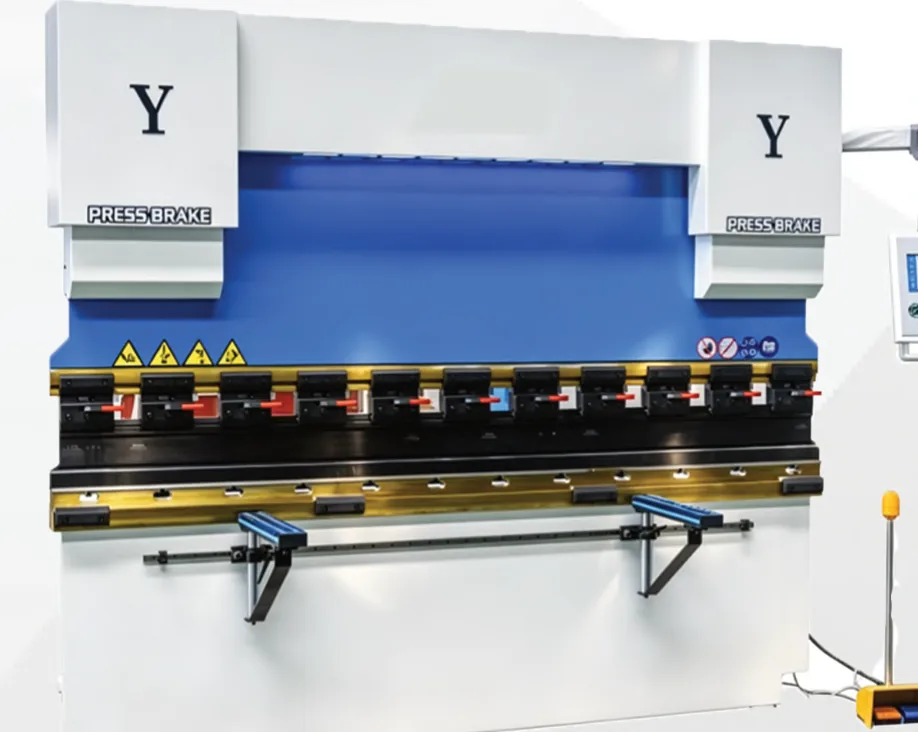
| CNC press brake | Bends cut sheets to accurate, repeatable angles | Tonnage, bending length, number of axes, tooling |
| Hydraulic shears | Straight cutting of plates | Plate thickness and cutting length |
| CNC machines and steel processing lines | Machining and processing of metal within a production line | Final product, output and configuration |
Many workshops start with a laser cutter and a press brake together, because cut parts usually need bending afterwards.
Buyer checklist: questions to answer before you request a quotation
- Metals and thickness: mild steel, stainless steel, aluminium or galvanised sheet? What is the maximum thickness you cut regularly, not only occasionally?
- Sheet size: the sheet sizes available in your market decide the right cutting-table size.
- Output: number of parts or tonnes per month, and number of shifts.
- Precision and edge finish: do you need clean edges without extra finishing? This affects the assist gas and laser power.
- Software and operation: drawing and nesting software, controller interface language and operator training.
- Utilities: available electrical supply, compressed air or nitrogen/oxygen gas, cooling and fume extraction.
- Safety: laser enclosure or guarding, hand protection on the press brake, and compliance with your country’s rules.
- Spare parts and service: lenses, nozzles and tooling are consumables; plan them from day one with RendatSP.
What the Eirmac catalogue lists
The figures below are taken only from the published Eirmac catalogue summary on our Arabic Eirmac catalogue page. The exact configuration for your project is confirmed in the quotation.
Fiber laser cutting machines
- Single platform: cutting areas 3015 (3000×1500), 4015 (4000×1500), 4020 (4000×2000), 6015 (6000×1500), 6020 (6000×2000) and 6025 (6000×2500) mm. A dual-platform version is listed as an option.
- Tube laser cutting: models listed by length × diameter: 6000×Ø120, 6000×Ø160 and 6000×Ø240 mm.
CNC press brakes
- Hybrid (electric + hydraulic): 6+1 axes as standard, single-pump models from 70T/2500 and dual-pump models up to 320T/4000. Optional DELEM / CYBELEC / ESA controllers.
- Servo torsion-axis press brakes: 2 axes (X + Y) as standard with 3, 3+1 and 4+1 axes optional; models from 30T/1600 to 300T/4000.
- Small electro-hydraulic and fully electric press brakes: smaller models for light, precise bending work.
Common mistakes to avoid
- Buying more, or less, laser power than you really need without test cuts on your own samples.
- Ignoring the cost of gas, electricity and consumables when comparing offers.
- Choosing a press brake whose length or tonnage does not fit your largest part.
- Not preparing the floor, foundations and space before the machine arrives.
How Eirmac and Rendat support your project
Eirmac machines are supplied through Rendat with layout support, factory testing before delivery, export shipping, installation guidance, operator training and long-term spare parts from RendatSP. Send drawings or photos of your parts, the metals and thicknesses, and your target output, and the team will propose a suitable configuration. See also our turnkey services and the production line spare parts guide.
Frequently asked questions
What laser power do I need?
It depends on the metal, the maximum thickness and the cutting speed you need. The best approach is to ask for test cuts or cutting data on your own samples before deciding.
Can a fiber laser cut tubes?
Some machines cut sheets only; others include a tube unit or are dedicated tube cutters. The Eirmac catalogue lists separate tube laser cutting models. State your need in the enquiry.
How do I choose press brake tonnage?
From the metal type, thickness, bending length and die opening. The supplier calculates it from a bending table for your parts, not from a general number.
How long do installation and training take?
It depends on site readiness and utilities. Ask for a schedule together with the quotation.
How much does a fiber laser cutting machine cost?
There is no single price; it varies with size, power and configuration. A quotation follows a study of your requirements.
Request a quotation
Send the metals, maximum thickness, sheet size, monthly output and your country. Contact Rendat, email info@rendat.com or WhatsApp +86 181 5871 1787.